Tuesday, April 16, 2013

Ethical Eating, circa 2003

This is an editorial I wrote for The Aquarian back in the fall of 2003. As far as I can tell, it's one of the first times the term "ethical eating" was used to describe the then nascent movement. It was also the theme of the issue. Recently, The Aquarian's website was overhauled. Very little pre-2008 content made the transition, including my precious editorial! For now, at least, this will be its new forever home online.
SB


The Aquarian, Fall 2003
Ethical Eating 
It's time to extend our sphere of moral concern to include the lives that sustain us

By Syd Baumel, Editor

A little over a year ago, two years into my transition from mild-mannered vegetarian to in-your-face vegan, I came to the conclusion that most people don't want to buy what I have to sell. I was failing in my would-be mission as an advocate for the nearly 50 billion farm animals slaughtered every year around the world. The goal posts of vegetarianism, much less vegansim, were set far too high for most people – and some questioned the goal itself.

Might there be a better way, I wondered, for my ethical vegetarian colleagues and I to reach the resistant masses? It has always been anguishingly obvious to people like us that most nonvegetarians do love animals; yet . . . they still eat them.

I found myself meditating on this challenge at the lake that summer, and quickly a vision of another strategy took shape.

Compromise. Tell people any change is better than no change at all. 

Get people and organizations of influence – movie stars, political and spiritual leaders, scientists, intellectuals – to speak up with one voice for ethical eating. Reframe the message from all-or-nothing veganism to anything-is-better-than-nothingism and the-more-the-betterism. As I was later to write in a letter to The New York Times Magazine, the opposite kind of all-or-nothing reasoning by the magazine's food columnist – that "if you cannot be merciful to all edible animals, you needn't be merciful to any" – "is a recipe for moral indifference. Every act of mercy is a sufficient act of kindness unto itself."

In other words, I wanted myself, my activist colleagues, and others not yet even involved in this inclusive mass movement to send people an alternative message about food: you don't have to be ethical all the time (or according to other people's standards) to be ethical. You don't have to be the Dalai Lama to be a good guy – indeed, even the Dalai Lama eats meat every other day.*

You're probably not a vegetarian either. Only about 4% of Canadians are. But I bet you're concerned about issues related to your dietary choices – issues like protecting the environment, supporting farmers and other people in the food production chain, being kind to animals, and eliminating world hunger.

Perhaps you're buying organic food more often because it's better for the environment, for farmers and public health, and typically for animals too. Perhaps you're eating more humane-certified, free range, or grazed/pastured animal products because you believe any animal that puts food on your table ought to be treated with at least a little compassion.

Perhaps you oppose genetically modified crops because you believe they pose a threat to biodiversity – and therefore to the world's food security – or because you worry that GMOs threaten public health.

Perhaps you drink fair trade coffee or tea or eat fair trade chocolate so as not to support the exploitation of impoverished farmers in the developing world – even child slaves, in the case of chocolate.

Perhaps you give generously to aid agencies or donate to food banks so that others can eat too.

If you do any of these things, you're part of a burgeoning, spontaneous, and so far nameless movement (I would call it the ethical eating movement, a subset of ethical consumerism) of people who strive to eat not just what's good for number one, but what's good for everyone. You are extending your sphere of moral interest to include the very food chain that sustains you. You are co-authoring a new chapter in the moral awakening of humanity. Ethical eating, like ethical living, is not about absolutes. It's about doing the best you're willing and able to do – and nurturing a will to keep doing better.
____________


This issue of The Aquarian encompasses much of the spectrum of complementary and conflicting views about ethical eating.

In "Elk Spirit," Michele Murray expresses a conviction shared by many that a spiritual communion between human predator and animal prey sanctifies the eating of meat "to live another day."

In a letter to the editor, Bettie Malofie, whose love of animals prevents her from thinking of killing the spent egg-laying hens in her small, home-based sanctuary, undergirds that position with her view that it's hard for people to be healthy on a vegan diet. Speaking personally, I have yet to meet or hear of an "at-death's-door vegan" (to use Malofie's vivid expression) who had also taken care to ensure an adequate dietary and/or supplemental intake of the nutrients that can be low or absent on an animal-free diet (the usual suspects: vitamin B12, vitamin D, iron, zinc, protein, omega-3 fatty acids, and carnitine; omnivores are more likely to be deficient in such nutrients as folic acid, vitamin C, vitamin K, and fibre, and to eat too much saturated fat, retinol, and cholesterol). My own "at death's door" experience as a vegan (a couple weeks of profound, chronic energy failure) was promptly cured by a vegetarian-source supplement of carnitine, a nonessential nutrient found mostly in red meat. I consider this a very small price to pay (though I have to mail-order it from the US!) and am no more bothered by its "unnaturalness" than I am by central heating or reading glasses.

Also in this Food for Thought issue, Michele Murray's deeply felt refrain about eating prey "so we can live another day" finds its opposite echo in vegan ex-cattle rancher Howard Lyman's avowal that "the thing that gives me the greatest joy in the world is to be able to say to you that no animal has to die for me to live."

What would The Aquarian's advice columnist Ajna have to say about such conflicting views among ethical eaters? I asked her. She answered thoughtfully; but, being the editor, I muscled in with my own answer too (call me "Ahimsa"). Perhaps you would have answered differently. Or maybe you have other views about ethical eating that you'd like to share. Send them to us. We need to talk about this.


*The Dalai Lama tried being a vegetarian in the 1960s, developed jaundice (hepatitis), and was ordered by his doctors to eat meat again. This is not known to be a complication of vegetarianism and may have been coincidental or the result of an unbalanced vegetarian diet: reportedly, the Dalai Lama had subsisted mostly on nuts and milk. In large, controlled, long-term studies, vegetarians and vegans have tended to be slightly healthier and possibly longer-lived than comparable nonvegetarians. The American Dietetic Association and the Dietitians of Canada have consistently endorsed the safety and healthfulness of a well-planned vegetarian or vegan diet. 
UPDATE, December 2004: In a Reader's Digest interview this year, The Dalai Lama said he is now entirely vegetarian, except when he's on the road. "My kitchen is now totally vegetarian," he said. "But when I visit places, occasionally I take non-vegetarian..."

Thursday, September 16, 2010

Farmuseum Raided: Meat Trafficking Suspected

September 16, 2036

Farmuseum Raided: Meat Trafficking Suspected

By Justin Terranova, The Canadian Press

WINNIPEG - Residents of a quiet Winnipeg suburb are in shock today after police raided a Registered Farm Animal Preserve, uncovering evidence of an illegal meat trafficking operation.

Police were tipped off by an unidentified employee of the Crescentwood Heritage Farm Animal Preserve and Education Centre, one of 175 nationally accredited farmuseums in Canada.

“We discovered a hidden onsite abattoir and the remains of at least half a dozen animals, including cows, pigs and poultry,” said Winnipeg police spokesperson Darius McIntyre. “Our informant claims the meat is being sold into the illegal meat market, and we are vigorously pursuing her lead.”

Cassandra Chernowski has lived near the Crescentwood centre since 2029. “This is a cherished family place, a wonderful farmuseum where my children have spent many, many happy hours with some of nature’s dearest creatures," Chernowski said. "I am so sickened that some of these animals were being murdered for their meat.”

Non-medicinal meat has been illegal in Canada since 2025 when parliament passed Bill 725, banning the killing of animals for food or fibre, except for medical necessity, subsistence or survival. Although a dozen small medicinal meat farms were licensed by the federal government, only a handful remain.

“Because of the health adequacy for most Canadians of meat, fish, dairy and egg substitutes, nutritional supplements and medicinal eggs and dairy products from no-kill farmuseums, only seven animals were legally killed for meat in Canada last year,” the Canadian Food Inspection Agency said in a statement released today.

In the United States, which passed similar legislation in 2024, 37 animals were legally killed for meat last year. Worldwide, the number of countries where the non-medicinal production of meat is still legal has shrunk to 24. In 2029, the historic Animal Rights and Welfare Declaration of the United Nations Parliamentary Assembly condemned the practice, although the declaration is not yet legally binding.

Since 2029, processed human waste, or humanure, has become the most widely used agricultural fertilizer in Canada and most other countries, all but replacing animal-based fertilizer and largely replacing artificial fertilizers, too, according to the UN Food and Agriculture Organization.

“We used to buy eggs from the Crescentwood farmuseum every Christmas,” said Ms. Chernowski. “They’re very expensive, but my grandparents love them. We always assumed the hens were lovingly cared for. But now... The children are so upset.”

Sunday, December 6, 2009

Humane Humanure

One of the foundational arguments for animal farming is that livestock provide free, organic manure - manure that even vegans need if they want their foods to be organically produced. The argument is especially key among advocates of organic animal farming. While I support humane organic animal farms (not all are particularly humane, but they exist and I've visited some of them) as an alternative to factory farms, I don't accept the argument about manure.

For one thing, nitrogen-rich cover crops can be used as "green manure." That may or may not be as efficient as tapping into the brown manure of a mixed farming system. But no one can argue that we already are sitting on a vast reserve of untapped animal manure. Our own.

A story last week in Time Magazine is a fresh (no crude wordplay intended) update on the status of the "humanure" alternative, with the emphasis on its use in urban gardening. There's no reason, however, why modest technological innovations couldn't efficiently convey vast quantities of humanure from town to country in order to reduce agriculture's dependence both on artificial fertilizers and on the manure of captive food animals.

In my humanure-powered vegan utopia, all those farm animals we've loved since childhood still exist. Indeed they thrive as never before. That's because we breed them in small numbers on no-kill farms where we can visit and appreciate them alive, not dead, and even enjoy their milk, eggs, wool and skins, because now we come by these animal products nonviolently instead of in the abusive and murderous ways we did before.

Thursday, December 18, 2008

Gone YouTube

Over the past few years I've created and been involved in the making of a number of films and videos, most of them centering on the subject of this blog. A few days ago, I began uploading my videos to YouTube. You can access them from here. 

The one below is most apropos the holiday season. It's a none-too-subtle attempt to get viewers to take a pass on foods borne of animal abuse during this "good will to men" time of year ... and all year (New Year's resolution, anyone?). The great Albert Schweitzer - a deeply spiritual Christian whose Christmas celebrations likely were vegetarian or very close to it - famously said:
"Until he extends his circle of compassion to include all living things, man will not himself find peace." (Pardon the sexist language. This is an old quote.)
Extending our circle of compassion to animals who are so much like us and who are barely distinguishable from our companion animals is what this video is about. 

If you want to watch YouTube's highest quality stream of the video (recommended - it's much better), please view it directly on YouTube, here, and select "watch in high quality" at the bottom right, below the video.


Monday, December 8, 2008

Take a bite out of the global grain crunch

In his latest column, the ever insightful progressive Canadian columnist Gwynne Dyer sounds the alarm about a potentially catastrophic global grain crunch brought on by climate change.

To my pleasant surprise, the ever environmentally regressive editors of the Winnipeg Free Press published Dyer's column today. I couldn't resist sending a letter to the editor pointing out a solution to the grain crisis which Dyer didn't mention:

Re: "It's worse than you think," Dec 7

The simplest, most sensible thing we can do to take a crippling bite out of the global grain crunch is to eat less meat, milk and eggs from grain-fed animals – or eat none at all.

Currently nearly 40 per cent of global grain production is fed to farmed animals, squandering eight pounds of plant protein (on average) to produce one pound of animal protein.

It's not that the animals should be denied their food. Most of them, born and raised in confined feeding operations, or factory farms, would be better off having never been born at all. It is we who breed them into a world of pain.

By eating more grains and beans instead of meat, eggs and milk, we can achieve four social goods:

  • Make more grain available to the global poor at cheaper prices.

  • Improve human health and longevity (as the research shows).

  • Reduce global warming (livestock production generates far more greenhouse gases than plant production).

  • And save animals from the abuse that is the hallmark of modern livestock production.

Syd Baumel
Winnipeg

Wednesday, December 3, 2008

Prop 2 for Canada long overdue

Originally published in The Aquarian, Winter 2008

A Modest Proposition

California has illegalized cruelty to farm animals. Why can't we?

By SYD BAUMEL

It wasn't just hope that got a new lease on life on November 4th. As California voters clinched the deal for Barack Obama, they also voted nearly two to one to ban some of the most unconscionable acts of animal cruelty. (Ironically, they voted against gay marriage while they were at it.)

Thanks to the passage of Proposition 2: The Prevention of Farm Animal Cruelty Act, on January 1, 2015 it will no longer be legal in the Governator state to house sows in cages barely bigger than their bodies, to stuff egg-laying hens into cages so crowded they can't even stretch their wings or to lock baby calves into closet-sized stalls for the rest of their lives as veal-in-waiting.

Thank God Californians have finally caught up to Canada, eh!

Well – not so fast. It's we who have to catch up to California, not to mention several smaller states that have passed similar legislation ... and the entire European Union.

Remarkably, the country that thinks of itself as a bastion of progressivism, a gentle, wouldn't-hurt-a-fly neighbour to the land of sharp elbows, still issues “Recommended Codes of Practice” to the livestock industry that condone everything California just banned.

It gets worse. While the EU imposes a limit of 8 hours on the amount of time farm animals can be transported without water on their way to auction or slaughter, and the United States thinks 28 hours without food, drink or rest is as bad as it should get, the Canadian Food Inspection Agency (CFIA) clings to antediluvian legislation that says it's just fine to haul farm animals in unheated, un-air-conditioned trucks through whatever weather Canada can throw at them for up to 52 hours without any relief: no food, no water, no rest stop. (The 52-hour limit is for cows and other ruminants. Non-ruminants like pigs, poultry and horses, have it good: they only have to endure 36 hours. Millions of these animals are exported to the U.S. and sometimes farther. When they cross the border, the clock is reset to zero.)

The Canadian Coalition for Farm Animals (CCFA) – the closest thing our hundreds of millions of farm critters have to a lobbyist in Ottawa – has been trying to buttonhole our national Minister of Agriculture and Agri-Food about these matters, but Gerry Ritz, they say, only has time for the industry that mistreats the animals.

“Mr. Ritz has no apparent interest in promoting the welfare of farm animals,” CCFA stated in a news release a couple days after California passed Proposition 2. “His department’s new five-year, $1.3 billion agriculture policy, Growing Forward Framework Agreement, includes no reference to animal welfare.”

If Ritz won't listen to a coalition of humane societies (including Winnipeg's) and other animal welfare groups, perhaps he'll listen directly to voters. That's what CCFA hopes. “To ask him how he is planning to improve conditions for farm animals in Canada,” they suggest, “call 613.995.7080 or visit www.gerryritz.com.”

Here in Manitoba, the Winnipeg Humane Society's Quit Stalling campaign has tried for years to get our provincial leaders to ban the use of 2 x 7 foot cages as living quarters for hundreds of thousands of pregnant sows (one of the practices to be outlawed in California). They too are finding that Ritz's provincial counterpart, Rosann Wowchuk, has a tin ear for farm animal cruelty. Perhaps she'll take the issue seriously if you call her at work at 945-3722.

While we're waiting for our leaders to figure out if cruelty to farm animals is an issue worth bothering about, we all can vote for Proposition 2 by refusing to eat anything that is the product of legalized animal cruelty.


Aquarian co-editor Syd Baumel is a cofounder of AnimalWatch Manitoba and the publisher of Eatkind.net. Both are members of the Canadian Coalition for Farm Animals.

LEARN MORE


Sunday, August 12, 2007

A sustainable harvest for Central America

While the developed world is increasingly embracing sustainable agriculture and ethical eating, a nagging worry is that the developing world – where agriculture is growing at a much faster pace – will continue to imitate the unsustainable Western industrial model: factory farms, vast monocrops addicted to petrochemical inputs, and so on. (It's a lot like the climate change predicament where countries like China and India threaten to become the new global centres of dirty coal power production – especially if certain Western superpowers continue to build new coal plants themselves.)

Last month, I received an email from Jessica Schessler, a young American student who is interning this summer for Sustainable Harvest International, a small nonprofit organization that is trying to buck this agricultural trend. I asked Jessica (that's her below, drinking - I think it's a safe bet - a cup of fair-trade java) what motivated her to get involved with SHI. She replied:

“As a college student, I was looking for summer work and really wanted something different than retail, sales, etc.. I've always wanted to do something that made me feel like I made some sort of difference....Now, I've learned so much about what they do, about the environment, and about how we impact the world that I've started to change my everyday habits for the better. I certainly wouldn't expect all of that would've happened working fast food or customer service!”

Jessica asked me if she could write about SHI in the Ethical Eating blog. After visiting the SHI website and being very impressed with the kind of work they do (and their 4-star rating from Charity Navigator), I agreed. Here's what Jessica wrote:

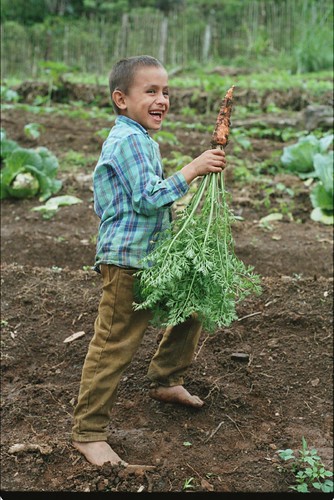
Becoming green and saving the environment has become quite the hot topic. Plenty of people and organizations try to remedy these issues at home and abroad as well, but where some fall short is making sure that the programs they place are not just good for the Earth, but for the people in the area as well. Sustainable Harvest International is heading straight for one source. This small non-profit organization “has worked with nearly 1,000 families and 900 students in Honduras, Panama, Belize and Nicaragua implementing alternatives to slash-and-burn farming, the leading cause of rainforest destruction in the region.” Malnutrition is a huge problem in this area of the world, and many vegetables are considered a luxury item. SHI teaches new farming techniques to the local families, such as alley cropping, organic vegetable gardening, and seed saving and storage.

Since 1997, SHI has successfully:

  • Planted more than 2,000,000 trees.

  • Converted 6,000 acres to sustainable uses, thereby saving 30,000 acres from slash-and-burn destruction.

  • Improved nutrition through the establishment of more than 200 organic vegetable gardens.

  • Increased farm income up to 800%.

  • Built 165 wood-conserving stoves (saving 1,650 trees per year)

Cruz Alcidez has worked with SHI for 5 months, “I began working with SHI because I wanted to learn new planting techniques and also to learn about sustainability. I am especially thankful to SHI because I now have timber-yielding trees that will remain forever on my farm. The benefits for my family are many, because SHI supplied me with many seeds including beans, cabbage, beets, and soy beans. As you know, this last one (soy) can be used to prepare a lot of different foods, including cuajada, a type of soy cheese, which is very nutritious for my family.”

What better way to stop slash and burn than with education in alternative farming techniques? SHI’s programs not only help out the farmers and their families, but the environment as well.

Now, did you know that it’s possible to eat yogurt, help these farmers, save forests, and get free organic chocolate and tea all at the same time? Stonyfield Farm is featuring SHI along with two other non-profits on their yogurt lids this summer. Vote for your favorite non-profit and help direct funds their way, while getting cool prizes!

Visit http://www.sustainableharvest.org/yogurt/ for more information on SHI and Stonyfield’s “Bid With Your Lid” program.

Jessica Schessler

_______________________________

I do have to point out the irony that yogurt made from milk from nonorganic dairies is being used to promote and (hopefully) help finance the ethical agricultural efforts of SHI. Stonyfield Farm's yogurt is rBST-free, which means the cows in the dairies they source their milk from are not fed a growth hormone that would make them more productive at the expense of their health and well-being (and possibly the health of people who eat it). But those dairies aren't organic, which means the cows are probably treated as milk machines - essentially slave labour.

On the positive side, Stonyfield also offers organic yogurt. The cows in certified organic dairies are treated better and may even be treated very well in some, but most of their newborn calves are ripped away from them within days of birth to be sold to the veal industry - nothing pretty or respectful of life there. Much more hearteningly, Stonyfield's O'SOY yogurt, which is made from organic soybeans and other organic ingredients, is also sporting a "bid with your lid" this summer. That one gets my bid.

Syd Baumel